
Supporting Children Who Stutter on National Children’s Mental Health Awareness Day
Updated: May 7
Just before the National Stuttering Association (NSA) celebrates National Stuttering Acceptance Week from May 9-15, it's also important to remember another key awareness day in May that resonates with parents, speech-language pathologists (SLPs), and mental health professionals: National Children’s Mental Health Day.
National Children’s Mental Health Day is observed annually on the first Thursday of May. This year, it falls on Thursday, May 7, 2026. Established by the Substance Abuse and Mental Health Services Administration (SAMHSA) in 2006, this day aims to highlight the mental health needs of children and teens. A 2021 study found that nearly 20% of children aged 3 to 17 had been diagnosed with a mental, emotional, or behavioral issue during childhood.
Students with communication differences, like stuttering, often face ongoing communication challenges that can heighten anxiety and depression. These students may feel isolated, have difficulty advocating for themselves, and experience depression.
To address the decline in mental health, proactive strategies can support students who stutter and promote their well-being at home and at school. These include in-school resources such as school counseling and speech therapy, as well as external services provided by licensed mental health clinicians. Let’s explore how mental health affects children and teens who stutter and how to honor NSAW in ways that support their social-emotional health:
Supporting the Emotional Experience of Stuttering
If you are parenting a child who stutters, the challenges of childhood stuttering can sometimes feel isolating, especially when others don’t see or understand what your child is experiencing. How do you support your child wholeheartedly while also managing the realistic demands of raising a neurodivergent child or teen with an invisible disability, like stuttering?
Using Stuttering-Affirming Language at Home
Being mindful of how you talk about stuttering at home can create a powerful, positive shift in your household. Stuttering-affirming language moves the focus away from trying to “fix” stuttering and instead fosters an uplifting, supportive view of your child’s communication difference. For example:
Instead of: “Slow down, take a breath, start over,” try: “I’m listening. Take your time.”
Instead of: “Use your strategies,” try: “What would help you feel more comfortable?”
“Adults can support children by normalizing stuttering, responding with patience, and modeling acceptance. It’s also important to listen without interrupting or finishing sentences, and to validate the child’s feelings without trying to immediately ‘fix’ them. When children feel emotionally safe, their confidence and communication naturally grow.” — Nicole Terhune, MS, CCC-SLP
Creating Confidence in Your Child Who Stutters
Just as the language you use around stuttering matters, being intentional about your actions around stuttering can have a powerful impact on your children who stutter. Instead of focusing on how your child speaks, focus on what they say. You can create “low-pressure” speaking opportunities to have your child practice their speech, like:
Family game nights where everyone takes turns telling stories or jokes
Letting the child choose when they’d like to order at restaurants
In these practice situations, you can also teach and model self-advocacy scripts for your child:
“Sometimes my words get stuck. Please give me a bit more time.”
“I stutter. It’s just how I talk.”
Practicing Mindfulness as a Family
Mindfulness means being fully present with a calm mind and body. Incorporating relaxation and grounding exercises into your family’s daily routine can improve your family’s social-emotional well-being. Many parents overlook how their emotions influence their children, but dedicating just 10 minutes daily to mindfulness can significantly benefit both their nervous systems.
Consider trying one of the following methods:
Finger breathing
Trace the outline of your hand with a finger, breathing in as you move up and out as you move down.
Progressive muscle relaxation
Tense different muscle groups while breathing in, and release them while breathing out to release stress.
Body scan
Listen to a script that allows you to focus your attention on different parts of your body, from your feet to the muscles in your face.
Practicing mindfulness together with your child fosters co-regulation, a process in which two people help each other stay calm. The Child Mind Institute explains that co-regulation is supported by science: our emotions, such as anger, can influence others to feel the same way. Effective co-regulation between an adult and a child involves guiding the child to self-soothe, which is why managing your own stress in a healthy way is the first step.
“Learning grounding and mindfulness techniques can help regulate the nervous system, tolerate distress, and support emotional regulation…When everyone slows down, breathes, and stays present, it supports the child who stutters and creates a calmer, more supportive environment.” — Nora O’Connor, LCSW
Creating Safe Spaces: A School Counselor’s Role in Supporting Students Who Stutter
As a certified school counselor in Pennsylvania, I support students’ social-emotional development. A 2021 American School Counselor Association study found that these interventions can improve stress tolerance, social curiosity, executive functioning, and academic achievement. Here’s how a school counselor can support students who stutter:
Identifying Emotions
Stuttering can be difficult for others to understand, and it can be hard to explain the internal struggle of dealing with a communication barrier. As a school counselor at an elementary school, I help students identify their feelings using visual tools, like a Feelings Wheel.
You choose an emotion and its associated color, such as "worried" and "purple," then follow that color to the outer ring, where more specific emotions appear. You can also have them practice using the feelings in sentences, for example: “I am feeling worried and insecure about stuttering during my class presentation.”
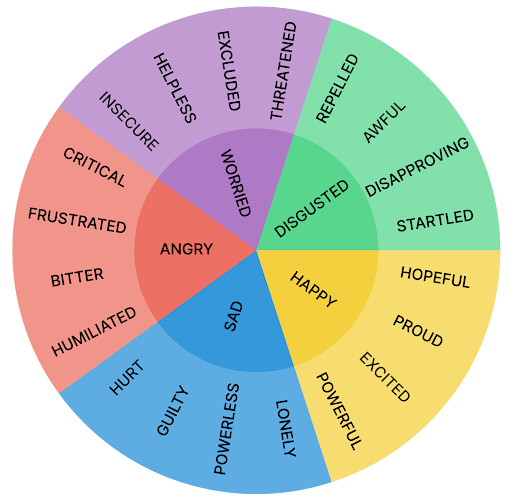
As adults, it’s our role to help children understand that it’s okay to have upsetting or frustrating emotions. For example, you might say, “It sounds like you’re having a rough speech day and feeling frustrated and embarrassed.” When you acknowledge their stutter and the challenging feelings around it, you show your student that their entire stuttering experience is recognized, understood, and accepted.
“When children are hurt, or in pain, our instinct [as parents] is to rescue them, but that’s often because we have a hard time seeing them suffer. What all of us need to hear is that it’s okay to be in pain, to feel sad, or to be in a difficult situation. I think that once we, as parents, teachers, and other caregivers, shift our thinking to recognize that it’s genuinely okay for our kids to struggle and have a hard time, we can be much more present with them...” — Eric Mendoza, PsyD
Developing a Growth Mindset
As a school counselor, I particularly enjoy teaching the distinction between a Growth Mindset and a Fixed Mindset.

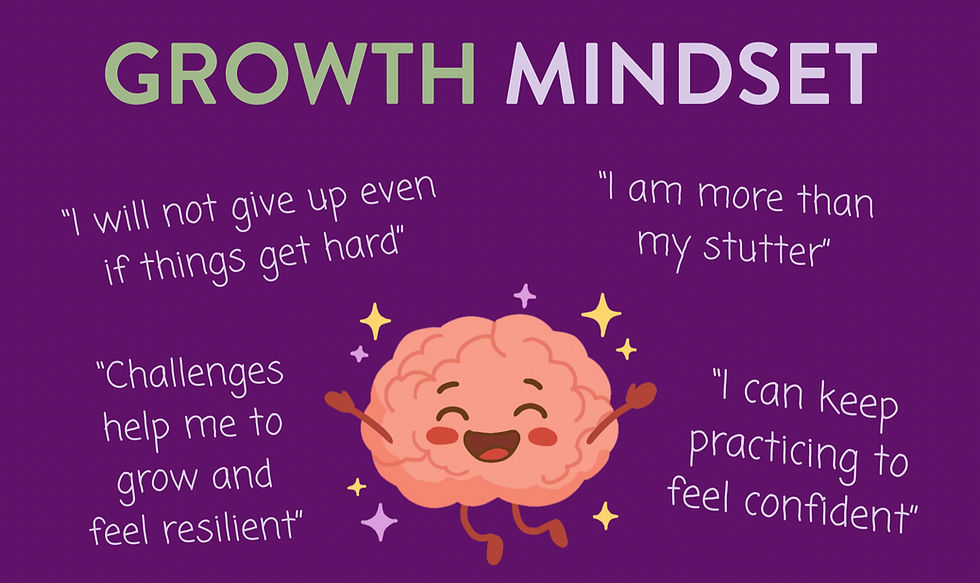
While it may seem straightforward, a Growth Mindset is about embracing challenges, feeling confident, and believing that effort leads to success. In contrast, a Fixed Mindset involves negative self-perceptions and doubts about one's abilities, as shown below:
Carol Dweck, the author of Mindsets and the Growth vs. Fixed theory, wrote, “The best things parents can do is to teach their children to love challenges, be intrigued by mistakes, enjoy effort, and keep on learning.” For parents of children who stutter, you can foster positive thinking in your child by:
Meeting your child where they are at: praise them for their efforts, not their abilities
Understanding the power of “yet”: encourage positive language by suggesting someone say, “I can’t do this…yet" instead of, “I can’t do this!"
Along with our different types of mindsets, I also enjoy teaching my students about resilience, the ability to “bounce back” from challenges. If you're attending this summer’s NSA Annual Conference in Charlotte, North Carolina, your children can join my social-emotional learning workshop, “Grow As We Go: Building Resilience from the Inside Out,” as part of the Kids conference programming.
Advocating for Students who Stutter
Being an “advocate” for all students is a foundational pillar of school counseling, as it is reflected in our professional guidelines. The ASCA Ethical Standards (2022) state that school counselors must “advocate for equitable, anti-oppressive and anti-bias policies and procedures, systems and practices, and provide effective, evidence-based and culturally sustaining interventions to address student needs.” There are several ways a school counselor can advocate for students who stutter, both directly and indirectly:

Classroom lessons
Facilitate lessons on diversity, conflict resolution, bullying, and respect. Use books like “Just Ask! Be Different, Be Brave, Be You” by Sonia Sotomayor, which features a child who stutters and explains that he sometimes repeats words or gets stuck, requiring more time to express himself!
Anti-Bullying Initiatives
Create a school-wide program like Kindness Day to focus on inclusion and teach conflict-resolution skills to prevent tension, such as using “I-Statements” (for example, “I didn’t like how you said I can’t talk… I wish you would please be nicer to me.”)
504 Plans
Students who stutter are often eligible for Section 504 Plans (legal accommodations) to address their communication needs. A school counselor facilitates 504 meetings, ensures teachers implement the accommodations, and may even serve as the 504 Case Manager responsible for the plan. You can learn more about 504s here!
Finding Your Voice: An SLP’s Role in Supporting Communication and Confidence
Nicole Terhune, M.S., CCC-SLP, is a SLP, clinical educator, and stuttering advocate on Instagram as @TheStutterAlly. Her experience working with children and teens who stutter helps her shift from a fluency-focused approach to a client-centered one. Nicole promotes a positive view of stuttering in youth by sharing that:
“I’ve seen how focusing only on speech can unintentionally communicate to children that the way they talk is 'wrong,’ which can impact self-esteem and willingness to participate. Professionally, working with children and families has shown me that stuttering is not just about speech. It’s incredibly complex and overlaps in the areas of identity, participation, and emotional safety. I prioritize creating spaces where children feel heard and do not feel constantly judged or criticized. I emphasize consciously validating their experiences, supporting their autonomy, and helping them express themselves in ways that feel authentic to them.”
Supporting Children Who Stutter Through Challenges
Nicole approaches situations like classroom presentations, social anxiety, and bullying with a balance of emotional support and practical strategies:
“We talk openly about stuttering and explore how it feels in different situations. From there, we build individualized strategies that often include learning about stuttering, role-playing difficult moments, practicing self-advocacy phrases, and identifying supportive people in their environment. When it comes to bullying, children must know it’s not their fault and that they have the right to be respected. I talk with my clients about others’ perspectives. I emphasize that the bully may not know anything about stuttering and that the behavior may stem from ignorance. I also collaborate closely with teachers and families to ensure the child is supported across settings. Most importantly, I help children understand that their voice is valuable regardless of how it sounds and that they deserve to take up as much space as they need.”
Collaborating with Caregivers and Educators
Nicole emphasizes that supporting children who stutter is a shared effort, and that small shifts in adult behavior can have a meaningful impact:
“Supporting a child who stutters can feel emotional for adults, especially when they want to help. One of the most important things is recognizing that you don’t have to ‘fix’ stuttering to support a child effectively. I recommend that adults focus on connecting with the child rather than correcting their speech, reflecting on their own beliefs and biases about communication, and seeking education and supportive communities to continue learning about stuttering and communication differences.I also collaborate closely with teachers and families so that strategies carry over across environments. When adults are consistent in how they respond and support communication, children have more opportunities to participate in ways that feel successful and sustainable.”
Encouraging Self-Advocacy and Emotional Well-Being
A key part of Nicole’s approach is helping children develop a sense of ownership over how they communicate and participate:
“I often tell children: ‘You don’t have to change the way you talk to be worth listening to.’ We work on understanding stuttering, building confidence in their identity, and learning to advocate for their needs—whether that’s asking for more time, explaining their stutter, or choosing how they want to participate. I also find it helpful to remind children that it’s okay to change their minds about what feels helpful during moments of stuttering. One day, they might want someone to finish their sentence, and the next day, they may not. Protecting their mental health also means recognizing when something feels too hard and knowing it’s okay to take breaks, ask for support, or do things differently. Their voice matters, whether they feel ready to take on speaking challenges or need to stay in spaces that feel safe.”
Holding Space for Emotions: Insights from Mental Health Experts on Stuttering
Being a mental health professional requires significant vulnerability. You work closely with individuals to discuss their struggles and create a safe, therapeutic environment. A communication barrier, such as stuttering, can be especially challenging in a role that involves a lot of speaking, such as being a therapist. The NSA consulted with two mental health clinicians who stutter: Eric Mendoza, PsyD, and Nora O’Connor, LCSW, and author of the upcoming workbook Navigating the Emotional Response to Stuttering, for their expert insights:
Meeting Children Who Stutter Where They Are
When asking how their personal experiences with stuttering have shaped the way they support children as mental health clinicians, they shared the following reflections:
“I meet the children I work with exactly where they are. I also allow myself to stutter loud and proud. I want to model for children that there's nothing wrong with the way they speak, and it's also okay to want to work on it. I remember exactly what it felt like to wish I didn't stutter, so I can make space for them to feel this way without trying to change it. I also strongly believe that when these children are having a difficult time, I can see their strong prognosis and future. With love, acceptance, and some courage, they can get to a place where stuttering doesn't need to disappear, but where they can be an authentic, confident, beautiful person who stutters in this world.” — Eric Mendoza, PsyD
“My experience allows me to go beyond technique and into the emotional truth of stuttering. I understand the anticipation, the body tension, the shame, and the constant mental gymnastics. That lived experience helps me meet children, teens, and adults where they are and help them understand themselves, normalize their experiences, regulate their nervous system, and build a healthier relationship with their stuttering.” — Nora O’Connor, LCSW
Making Space for the Emotions of Stuttering
When asked about the emotional challenges children who stutter encounter and ways adults can support them, both mental health experts highlighted that:
“I’d say the biggest emotional challenge I’ve seen, and one I deeply resonate with, is the feeling of being out of control… But instead of pulling them out of the hole, get in the hole with them. Sit with them. Listen. Validate… what helps most isn’t fixing it; it’s helping them feel like they’re not alone in it.”— Eric Mendoza, PsyD
“Shame is the biggest issue. It’s not just the stutter; it’s what children begin to believe about themselves because of it… Adults can help by creating environments where a child feels safe, not rushed or judged, and by giving them the time and space to speak without interruption or pressure… Children are not failures.”— Nora O’Connor, LCSW
Helping Children Who Stutter Thrive
When discussing bullying and anxiety, Eric and Nora both emphasized the importance of parents acknowledging and validating their children’s feelings:
“I don’t pretend [bullying] doesn’t hurt or that it shouldn’t matter, because it does. If a child is being picked on or feels anxious about speaking, that’s real. So the first step is helping them feel understood and not alone in that experience. A lot of it comes down to sitting with them in those moments and validating their feelings… At the same time, I want to help them build confidence in who they are, not in spite of stuttering but including it. We work on talking openly about their stutter, practicing how to respond if someone says something, learning to set a boundary, and slowly building their tolerance for those uncomfortable moments and a sense of control. I think something really important is helping them separate who they are from how others react. Just because someone laughs or doesn’t understand doesn’t mean there’s anything wrong with them. It says more about the other person. I also try to help them see that their voice matters, even if it comes out differently. And over time, the goal isn’t to eliminate anxiety completely. It’s to help them feel like, “Even if I feel anxious, I can still speak. I can still be myself." — Eric Mendoza, PsyD
“Bullying is very serious and harmful. Being open and honest about how difficult that experience can be is essential. We talk about what’s happening, how it feels in their body, and what thoughts come up. If a child cannot speak up for themselves, parents and guardians are responsible for advocating on their behalf. Don’t assume bullying isn’t happening just because your child isn’t telling you. Let’s assume it might be occurring, so we can prepare them for what they can do and what parents can do. For social anxiety, we normalize it. It’s okay to feel anxious, and we explore it together. Learning grounding and mindfulness techniques can help regulate the nervous system, tolerate distress, and support emotional regulation. Adults can also consider whether a child would benefit from seeing a mental health provider. Speech-language pathologists are often expected to address all aspects of stuttering, but it’s important to recognize when something is outside their scope and to refer out. Mental health professionals are trained to treat social anxiety and the emotional impact of stuttering. An SLP and a mental health therapist can collaborate in the child's best interests.”— Nora O’Connor, LCSW
Finding Strength Through Self-Acceptance
When offering advice directly to children who stutter, both clinicians emphasized the importance of authenticity, connection, and self-expression:
“Be your authentic self. The people you’re vulnerable with will become your strongest relationships. For me, stuttering, although it comes with many hardships, primarily internal but definitely shaped by external experiences too, is as corny and cliché as it sounds, has been an incredible gift. Find people who fully support you, where you don't feel the need to hide. I don’t think I’d be where I am today in my journey with stuttering without people who believed in me and mentors who helped me move toward acceptance…Lastly, people who stutter are just awesome! They're typically kind, genuine, and some of the best people I've ever met.”— Eric Mendoza, PsyD
“Your voice is yours, stutter and all. You don’t have to hide it or rush it. The goal isn’t perfect speech; it’s real communication. The more you let yourself be seen and heard as you are, the stronger you become. It’s also okay to feel sad, frustrated, or angry. Those feelings are real and powerful. Finding outlets is essential, such as music, sports, art, books, dancing, and other ways to express yourself. There’s more to you than your stutter, and it’s important to explore that. Get connected. Attend a stuttering self-help event in person and virtually. Meet other kids who stutter. You’re not alone in this.”— Nora O’Connor, LCSW
Prioritizing Self-Care While Caring for Others
Finally, both clinicians reflected on how they maintain their own well-being with self-care, while supporting children with similar lived experiences:
“Working with kids alone is healing. Accepting and genuinely loving every part of them heals the younger child in me. Having a daughter who stutters, loving every nuance of her voice, and making sure she knows that's what makes her unique and beautiful in this world, allows me to stutter openly. Embracing her stutter is healing for me.”— Eric Mendoza, PsyD
“Staying connected to my body and voice. I practice self-care through yoga and meditation, and I make time for things I enjoy. Staying connected with my family is also important to me. I stay in contact with friends who stutter, and that connection continues to ground me. Stuttering can still be hard work, even after all these years. As I stay grounded, I’m able to be fully present for the children, teens, and adults who stutter and seek my support.”— Nora O’Connor, LCSW
More Than Awareness: A Mental Health-Affirming Celebration of National Stuttering Acceptance Week
Instead of “National Stuttering Awareness Week,” our organization promotes open conversations about how awareness alone is not enough for people who stutter. We focus on acceptance, ensuring they are heard, respected, and supported daily.
Highlighting mental health encourages us to go beyond awareness and create safe, supportive environments for people who stutter. Here are some suggestions for children and family members to celebrate this week together while integrating social-emotional learning:
Create a “What helps me when talking feels hard” toolbox with grounding exercises, reminders of supportive people, and self-advocacy phrases
Draw or create an art collage on the topic: “My voice matters because…”
Read books featuring characters who stutter and talk about feelings in the story
“How do you think that character felt?”
“What helped them feel supported?”
Journal and reflect on “How does stuttering feel for me?” or explore your personal strengths besides your speech (example: your kindness, creativity, humor)
You’re Not Alone: Connecting to Support, Resources, and Community
No one needs to go through the stuttering journey alone. Community groups, in-school supports, or mental health services offer understanding environments that assist children, teens, and families.
If your family is looking for support, explore these resources as your next step:
This database helps families find mental health professionals who provide affirming, stuttering-informed care.
NSA chapters and support groups offer opportunities to connect with others who stutter, share experiences, and build lasting community in a welcoming, judgment-free environment.
Written by Lexi Hewitt for the National Stuttering Association, where people who stutter, families, and professionals find support, education, and community.


